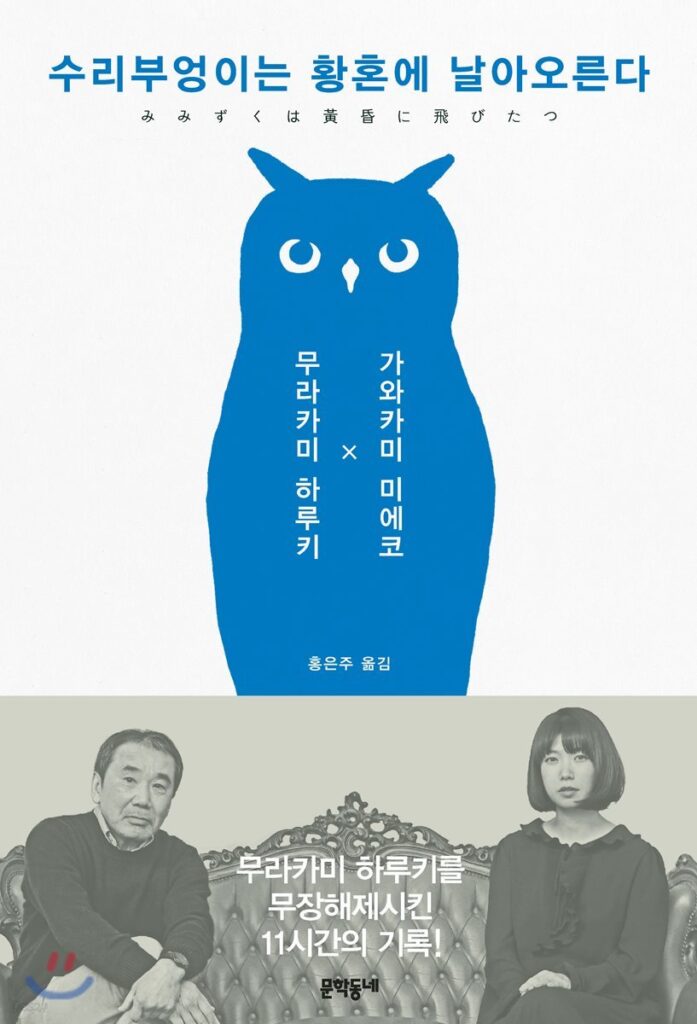
It’s impressive how Mieko Kawakami prepared intensely for the interview, but even more fascinating is Haruki Murakami, the master of improvisation, who never gives the expected answers. Truly remarkable!
This book is a collection of interviews between Haruki Murakami and writer Mieko Kawakami conducted during the time he was writing ‘Killing Commendatore’. To cut to the chase, it’s quite entertaining. Not mind-blowingly exciting, but… Murakami consistently emphasizes that aside from diligently writing a set amount daily, he follows no typical patterns, nor does he embed any specific messages or structural designs in his stories, leaving Kawakami, who is eager to discover something, quite perplexed. 📚 Yet, since it’s a full book, readers interested in writing may find value in observing his unique writing process.
As you dive into the book, you’ll notice it differs from typical author interviews. There’s a lot about constructing stories rather than technical writing, and the approach is quite unique. ‘How to technically weave sentences’ and ‘how to build a story’ are naturally different, after all.
Most writing books focus on how to create and connect sentences rather than crafting stories. Technical writing is more academic and can be approached logically without much trouble. Readers find this familiar too, as it’s what they’ve learned so far. But crafting a novel requires stitching pieces of events into a larger narrative that should neither be ordinary nor predictable. 🌟 And the way to achieve that is different for every author.
Murakami says that continuing to write technically when not ready is risky. When you get used to connecting scenes logically, it stops you from creating great work. The most crucial element in writing, according to Murakami, is time. ⏳ You can write anytime, but it’s essential to wait until the story bubbles up inside you, until you can’t help but write. Like a shopkeeper waiting for rain, a farmer waiting for harvest, or a fisherman waiting for the float to move, you need to wait for all the ideas to clump together into a story. Time never betrays.
This applies to writing, planning a business, painting, or even creating a PowerPoint presentation for work. Elevating the relationships between elements to something valuable requires more than just logical connections. Something beyond that is needed, and you never know when it will come. But with time, eventually, it will—just like catching a trout on a fishing trip, or rain falling at the start of winter. 🌧️
Another key point he emphasizes is the ability to craft well-rounded sentences with apt metaphors. Murakami believes this can improve with effort, though not many authors attempt it, in my opinion. When I browse through an author’s works—like a military officer scouring the genealogy of rebels for incriminating evidence—I find that while themes and stories differ, the style of description and expression often remains similar. This contrasts with movies, where many experts collaborate and provide feedback, unlike the solitary nature of a writer’s work.
While I respect his writing method, I hope not all authors follow it. Unpredictable plots are fascinating, but when every novel ends ambiguously without clear intent, it can be frustrating. Maybe it’s just me? It’s hard to create missing puzzle pieces or trace cause and effect when the author claims no original intent. Yet, I want to end by saying I really like his works. Here’s to hoping we get to enjoy even more of his future creations. 🌟
Leave a Reply