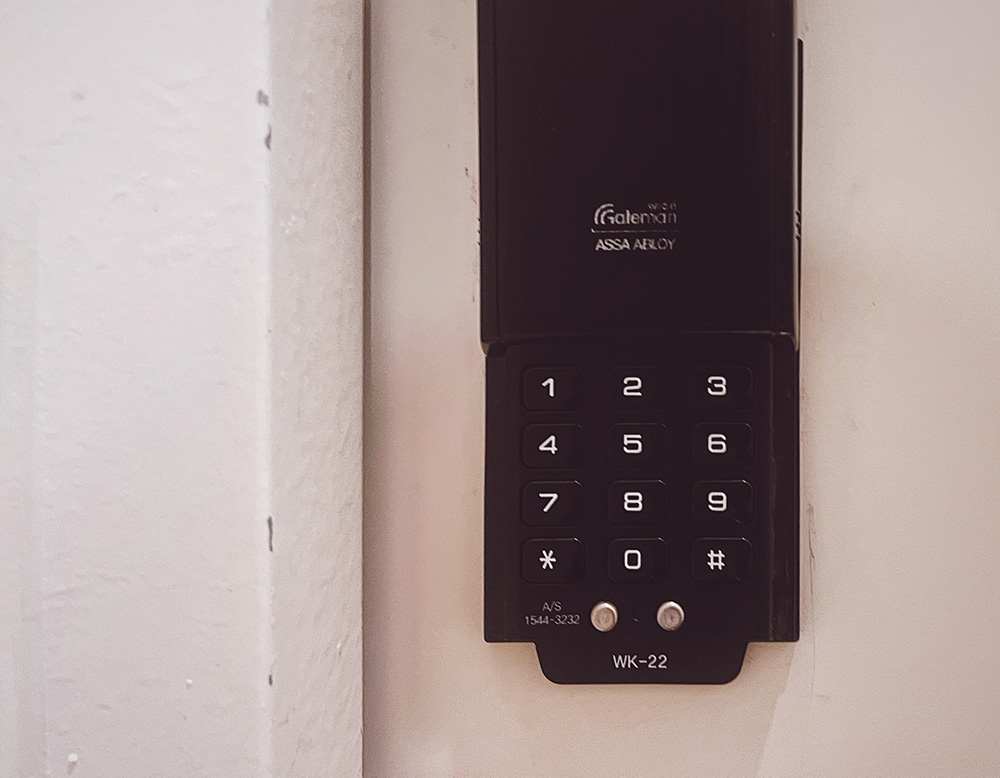
‘Isn’t that just weird?’
My friend returned from the bathroom, put down their glass, and started talking again. 😮
‘When did using door locks become some kind of secret knowledge?’
What in the world are they talking about? 🤔
‘Number pads on door locks have an asterisk (*) and a pound sign (#) on either side of zero. But first, let’s talk about number pads. Did you know there are two main types?’
Of course, I’m familiar with number pads. But I didn’t know there were several types! 😲
‘One type is used on phones with numbers arranged in ascending order from top to bottom: [123, 456, 789, 0]. The other is used on calculators, with numbers starting from the top left: [789, 456, 123, 0].’
Now that I think about it, the number layout on phones and keyboards is indeed different. But I never really noticed the difference until now. My friend kept talking.
‘The calculator number pad was first patented in 1914 by David Sundstrand, a Swedish-born American. While it’s considered logical, there isn’t much evidence supporting its efficiency, except for the convenient placement of frequently used zero at the bottom.’
Interesting quirks like that are everywhere. So, the phone number pad came later? 🤔
‘Exactly. In the 1950s, as phone dialing became more widespread, phone numbers lengthened, leading to more misdialed calls. AT&T engineers speculated it was due to inefficient keypads, and one prototype from their research is the number pad we use today.’
What’s with the asterisk (*) and pound (#) keys then? 🤨
‘When AT&T introduced the new keypad, they added two buttons: the asterisk (*) and the pound (#). The exact reason is unclear, but perhaps to allow flexibility for future functions and services.’
Why all the fuss? It’s not like the keypad inventor used special keys for something sinister. 😅
‘The asterisk (*) was initially used to access special services or functions, like voice mail or menu navigation. The pound (#) signaled the end of PIN or voicemail password entries.’
At this point, I couldn’t help but ask why all the annoyance?
‘Originally, the pound (#) was used to end password entries. So why do bathroom door locks require pressing (*) after entering a password? Look over there by the post. It only lists the bathroom password, not what to press to open the door. You’d think it’s common sense to press the pound, given its origin!’
…
..
.
‘Wouldn’t it be more intuitive to see password entry as a goal-oriented action for accessing the toilet?’ I wanted to say, but held back fearing the boring conversation would drag on.
Leave a Reply