Haruki Murakami makes a return with his new work, ‘The City and Its Uncertain Walls’, after quite a hiatus. If you’re a fan, the title might ring a bell because it’s the same as his novella from 1980. Back then, Murakami felt the story was incomplete and chose not to publish it. Later, he took the same theme and released ‘Hard-Boiled Wonderland and the End of the World’ in 1985.
Even though Murakami initially thought ‘The City and Its Uncertain Walls’ was lacking, the concept of a ‘city with uncertain walls’ was pretty much complete. If you look at the cities depicted in ‘Hard-Boiled Wonderland and the End of the World’ and the new novel, you’ll notice he used the original idea almost unchanged. Throughout his works, elements like the city walls, gatekeepers, libraries, dream reading, retired soldiers, unicorns, and shadows consistently appear, described in similar ways.
The latest release, ‘The City and Its Uncertain Walls’, adds details and an epilogue to the novella. Murakami himself mentioned in an afterword that he intended to stop after Chapter 1 but ended up adding Chapters 2 and 3.
The original ‘The City and Its Uncertain Walls’ was raw and terse, yet its theme and structure were captivating, a high-quality piece. Later, in ‘Hard-Boiled Wonderland and the End of the World’, Murakami replaced the real-world shadow boy and his love story with a near-future occult tale, crafting a new narrative. In this work, we experienced the ‘city with uncertain walls’ in a more polished style, and while the new story was somewhat organically connected to the original – under Murakami’s trademark (uncertain and enigmatic) storyline – one couldn’t help but feel the connection between the two worlds was lacking. ‘The End of the World’ had long been a completed tale, and the Hard-Boiled Wonderland part was later fit into that story. This made the original’s identity fade, likely leaving Murakami dissatisfied. Perhaps that’s why ‘The City and Its Uncertain Walls’ became a more sensitive topic for him after ‘Hard-Boiled Wonderland and the End of the World’.
Warning: Spoilers ahead, so if you plan to read the book, you might want to skip this part.
Let’s take a quick peek at the structure of this work. Chapter 1 closely follows the novella, with Murakami extending the initial scene featuring a young girl and boy, breathing life into their relationship. He also elaborates on the connection between the ‘city with uncertain walls’ and reality. In the original, both the protagonist and the shadow escape the city, but in the novel, only the shadow escapes. 🌆
I think the author’s initial intention was for them to escape the city and face reality, but in ‘Hard-Boiled Wonderland and the End of the World’, the narrative required only the shadow to escape. Similarly, in the novel, to construct Chapters 2 and 3, the main body had to remain in the city. (However, eventually, in the novel, the main body does escape the city.)
Chapter 2 deals with the shadow escaping, but for some reason, it also tells the story of returning to reality. Here, I live daily in an unreal situation within the library of the real world, encountering an autistic boy who knows about the ‘city with uncertain walls’. Chapter 3 is about this autistic boy sending me, still living in the uncertain world, back to reality. (This reveals to readers that the library director in reality was the shadow.) 📚
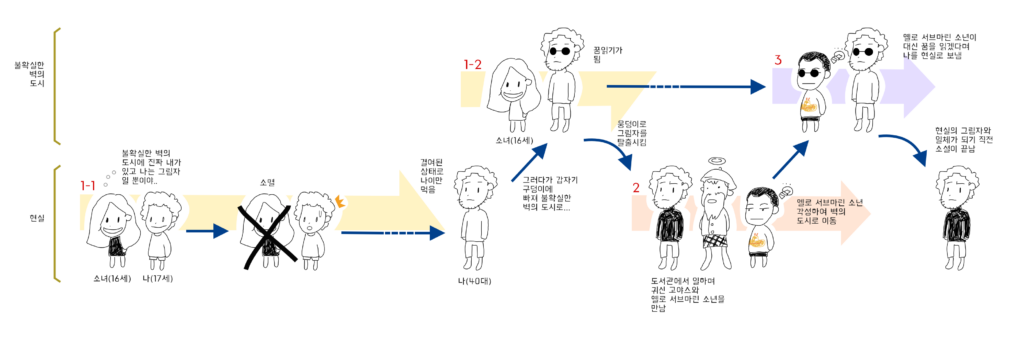
Originally, this novel was meant to conclude with Chapter 1, as the author mentioned. Back then, it probably ended with both the shadow and the main body escaping together, like the original novella. But the author decided to expand the story further, likely choosing to let only the shadow escape from the city as in ‘Hard-Boiled Wonderland and the End of the World’. To create an ending where I return, it had to be done this way. 🏃♂️
This novel leaves room for various interpretations of what the city with uncertain walls and reality mean, what the main body and shadow represent, and what the left side of the woman’s face, seen by the retired soldier, signifies. Leaving some threads unresolved or endings open to reader imagination is a hallmark of Murakami’s style and preference. While dual interpretations are possible, the city with uncertain walls is closer to a conceptual world. According to Koyasu, a person without a shadow is like a deceased person – a city with no shadows is a timeless place, an end-of-the-world for the dead. Within this setting, Murakami encourages readers to face reality, even if life might be painful and challenging, rather than retreat into silence. 🌌
Encountering a new work by a beloved author is like a personal festival that I can fully enjoy alone. Still, personally, the new ‘The City and Its Uncertain Walls’ fell short of expectations. The freshness of ‘The End of the World’ was already enjoyed in the original novella, and the delightful style and expressions were already experienced in ‘Hard-Boiled Wonderland and the End of the World’. It feels a bit like the juice has been all squeezed out. While more details have been added to the ‘End of the World’ story, the stylish and pretentious sentences of the previous works – though clumsy – resonated with me more. His more humble and serious style is flawless yet seems to have lost the sparkle it once had. I couldn’t find the compelling force that made one read on just for the sake of the next sentence. Nonetheless, I look forward to encountering more fresh and fantastic works, just as eagerly as before. ✨
To wrap up with the most memorable scene, I recall the part towards the end where he becomes younger and walks upstream of the stream with her. This scene mirrors the introduction of the original novella, where it was reality, but not so in the novel. A bit of 30-year magic realism, perhaps? 🌊
Anyway, I hope to dive into another of his works soon. 🌟
Leave a Reply