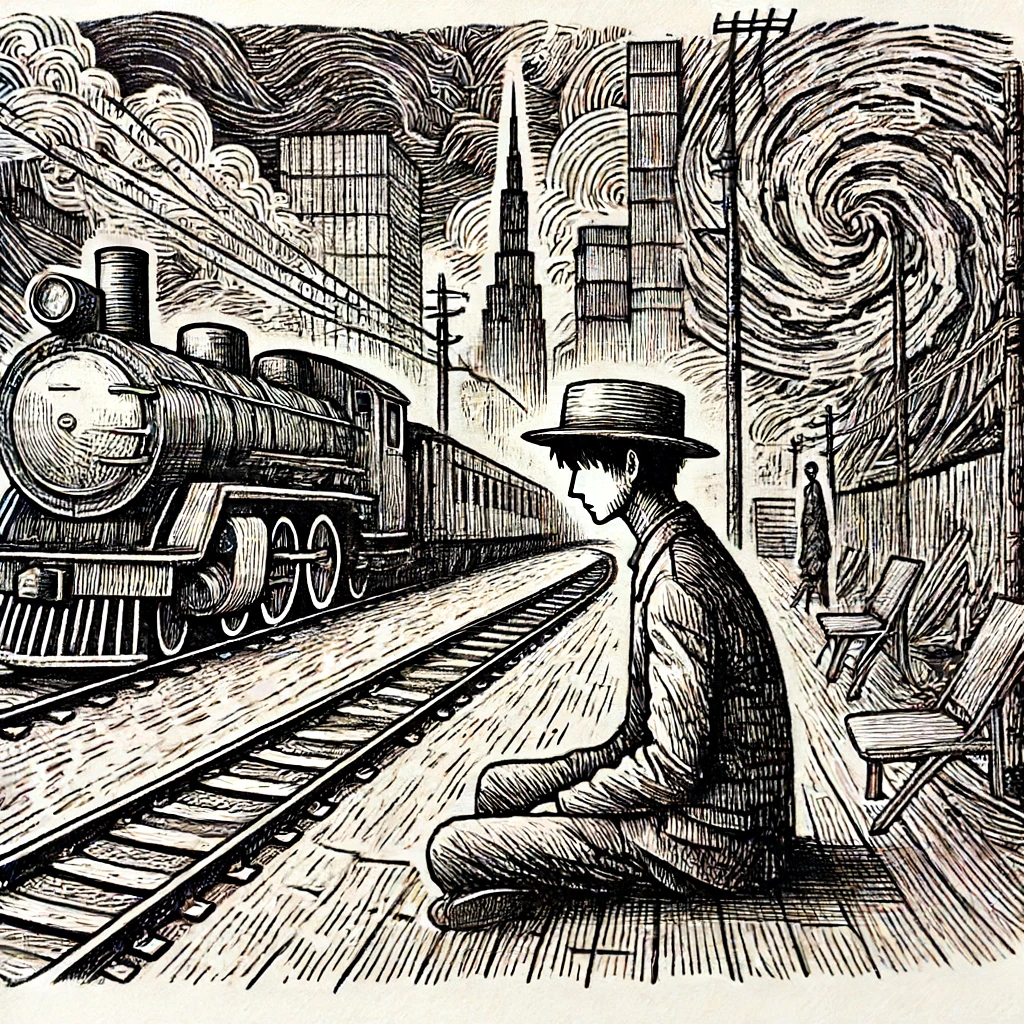
Murakami Haruki’s 2013 novel, ‘Colorless Tsukuru Tazaki and His Years of Pilgrimage’ (from here on, ‘Colorless Tsukuru Tazaki’), is a charming slice-of-life romance that runs parallel to his debut novel, ‘Norwegian Wood.’ Or perhaps, it’s more fitting to call it simply a slice-of-life novel.
Some folks say this was the turning point when Murakami’s wild popularity began to wane, and others feel that his repetitive themes of love and fate have become a bit stale. I get it. But personally, alongside his short story collection ‘Men Without Women,’ it’s one of my favorites, and I’ve always thought I’d share my thoughts on it someday. 😊
Crafting a story that feels real is no easy feat, especially when it’s set in our current world and not in the realms of sci-fi, horror, or the occult. Our familiarity with everyday life makes us crave fresh twists. That’s why contemporary novels often feature unique plotlines and elements like secrets of birth, sociopaths, and ambition, blending them into reality with a touch of the fantastic.
If a novel based on everyday reality feels dull, there’s usually just one reason: the writing doesn’t sparkle ✨. Sure, the writer needs to be skilled, but that’s no simple task. Especially now, when anyone can post online and make a debut of sorts. Creators lacking in foundational skills often lean heavily on unique storylines to fill the gaps. This applies to art and music too. For them, creativity and serendipity take precedence over technique. Meanwhile, those who have honed their craft the traditional way have a solid foundation, layering creativity and chance on top to create something uniquely theirs.
Yet, the challenge is that most people can’t recognize or appreciate these foundational skills. That’s the artistic dilemma. To put it simply, the majority of the audience can’t detect a lack of basics in a creator. Thus, these core skills must be transformed into something sensory and technical to be truly appreciated. Tricky stuff, right? 🤔
Murakami’s widespread appeal is often attributed to his ‘cool and unique stories featuring modern, detached protagonists.’ While that’s true, I believe the bedrock of his popularity is his ability to craft sentences that flow into sensory experiences. 🌊
His sentence-crafting skills are exceptional. Each of the thousands of sentences in a book is complete and delightful. Every sentence interacts with those around it in the most natural way. That’s why you can’t stop reading; the catharsis from their fluidity is immense. Each sentence serves as a medium to convey specific situations while standing as an independent, complete entity. This structural finesse makes the entire novel robust and solid. And on top of that, his unique storytelling builds the work’s identity. No surprises there, right? 😊
The same goes for ‘Colorless Tsukuru Tazaki.’ It may not have wildly unique events or unpredictable twists, yet you can’t put it down. This was true when I first read it upon release, and even recently on my second read (though, admittedly, I’d forgotten the plot by then).
I’m the type to mercilessly set aside books that don’t grab me, almost a dropout enthusiast. Sometimes, I wonder if I read just to find books to abandon! My meter’s always maxed out to the right, and I’ve never been the kind to think, ‘Maybe it’ll get better’ with warm optimism. That’s what makes Haruki a particularly special author to me.
If anyone picks up his book after reading this post and appreciates the solid fundamentals, that would make me quite happy. His sentence-building prowess isn’t something taught or theorized; it’s self-cultivated through instinct and effort. It’d be a shame to overlook it. 🌟
Though the internet is full of recommendations, if I were to suggest Murakami’s works to someone new to his style: for novels, definitely ‘Colorless Tsukuru Tazaki’; for short stories, ‘Men Without Women’; and for essays, ‘Factory of the Rising Sun.’ Not quite sure about my own tastes, so take it as just a suggestion. 😅
Leave a Reply