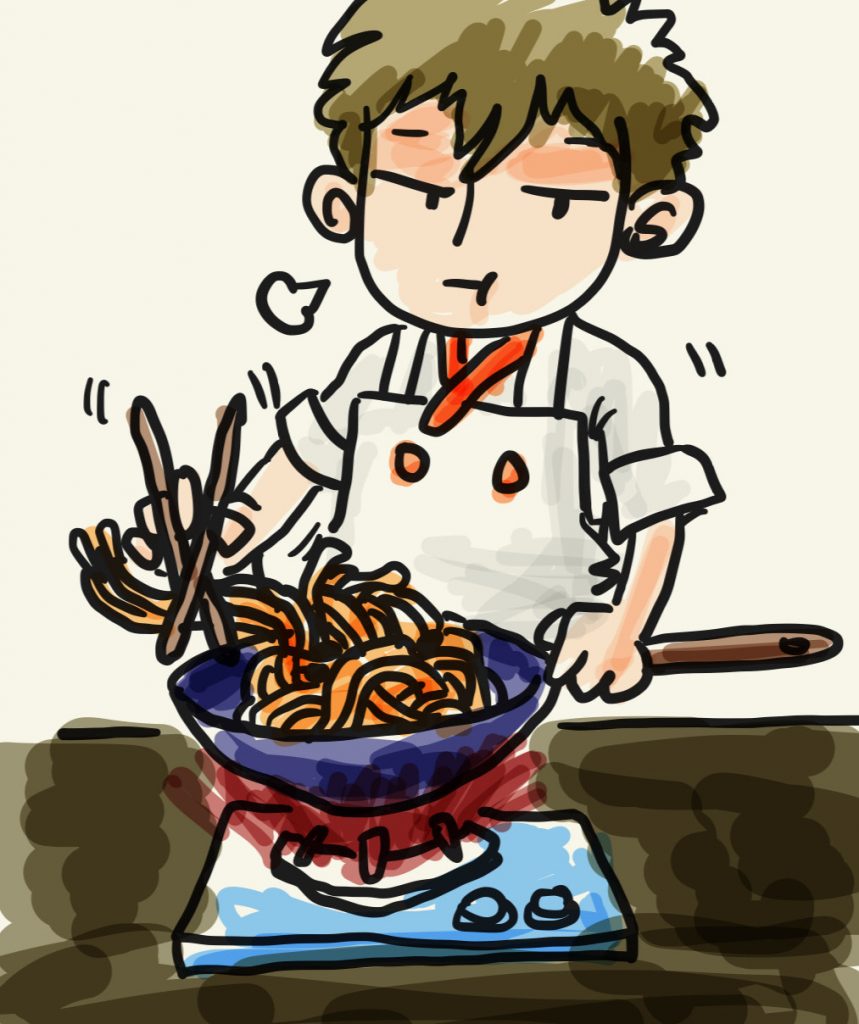
Throughout life, I’ve cooked Chapagetti my fair share. Cooking wasn’t my main gig, so I never really noted how my Chapagetti tasted. But recently, after a couple of lackluster attempts, I found myself deep in thought—and even took to Twitter about it.

Perhaps Chapagetti suddenly lost its charm. However, a quick internet search revealed that it’s still going strong, with a whopping 9.1 billion units sold over 40 years. If it really lost its flavor, would it still be this successful? 🤔
I wanted to analyze the reasons behind this. I needed to pinpoint where my judgment and actions were most involved in the cooking process. Since the ingredients are provided and I mostly follow the manual, there shouldn’t be many areas to focus on. I realized I had to break down the process in detail. Ignoring this might mean eating bland Chapagetti forever. ‘Forever’ has a way of feeling significant, like comparing ‘a few days of sniffles’ to ‘forever having a runny nose’.
Let’s take a closer look, step by step. 🚶♂️
1. Grab the noodles from the cupboard.
2. Tear open the packet.
3. Take out the noodles.
4. Measure water into a pot.
5. Turn on the heat.
6. (Once boiling) Add the noodles and garnish.
7. Wait.
8. Turn off the heat.
9. Drain the excess water.
10. Add the sauce and olive oil (I think?).
11. Mix it up.
The steps aren’t too complex, and thus shouldn’t be hard to analyze. Steps 1, 2, 3, 6, 7, 10, and 11 might not even be considered steps by most people. I realized they didn’t really affect the taste. Some might keep their noodles in a bookshelf, so maybe ‘cupboard’ should be generalized to ‘common noodle storage’. Some folks might have rituals while waiting, like chanting for flavor. But this analysis is all about logical exploration based on scientific curiosity.
Step 4, measuring water, is crucial for ramen but not for Chapagetti, as the boiling water only serves to cook the noodles. Since you discard it afterward, there’s no need to calculate a perfect ratio with the soup like in ramen. Steps 5 and 8 influence the cooking time and texture, but with Chapagetti, the thick noodles don’t stay in the broth long enough to affect taste, as long as they’re not undercooked. This leaves us with step 9: how much water to leave before mixing in the sauce.
This is it. Eureka! No need for further investigation. Looking back, I always hesitated when draining the water, unsure how much was left between the noodles and the pot’s curve. If I drained too much, the sauce would be too thick and choking on Chapagetti sounds dramatic. So, I cautiously drained the water for a while. The heavy cast iron pot made my arm ache, and it was tedious. I stopped draining when the water was no longer visible above the noodles. I recall thinking this when mixing in the sauce recently.
‘Is this pot a magic pot? Why does the water keep appearing?’
As a result, I ended up with soggy Chapagetti, reminiscent of stepping into a puddle during monsoon season. Wet noodles are just not tasty. So, what’s the secret to cooking the best Chapagetti? It’s tricky to gauge how much water to discard, so the real trick is not to drain at all. After a few experiments, I found the perfect amount of water for the noodles to blend beautifully with the sauce:
Boil with 320 milliliters of water.
After 4 minutes and 30 seconds, without turning off the heat, add the sauce. Stir until the noodles are glossy with sauce and the water is nearly gone. When the water’s mostly evaporated, turn off the heat and dig in. 🍜
If you follow my advice, you’ll taste the best Chapagetti ever.
Leave a Reply