Just a couple of days ago, the Claude 3 model was unveiled. Claude, from Anthropic, is a next-gen AI model similar to ChatGPT. Anthropic, for those who might not know, is a pretty big player in the AI space, founded entirely by former OpenAI staff. The Claude 3 Opus model is showing quality that surpasses ChatGPT4 in several benchmark tests, but in today’s AI world, every blink seems to bring a new model 💡. The open-source community is bustling with activity, making things even more exciting.
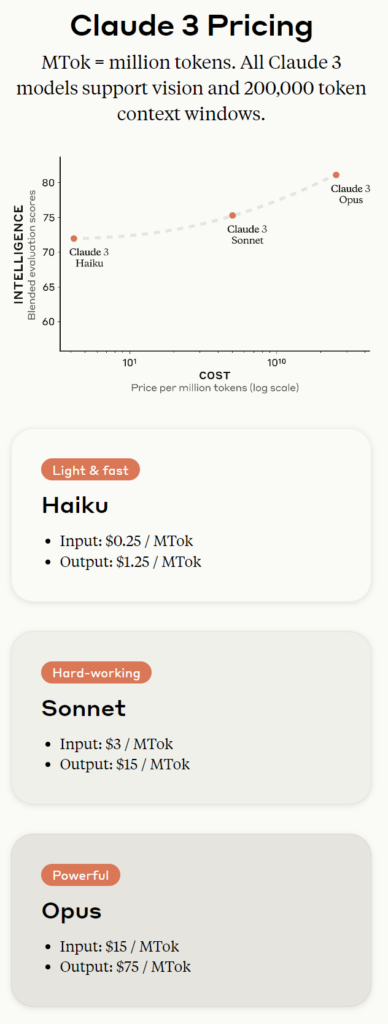
Anthropic has introduced three models: Opus, Sonnet, and Haiku, with Opus being the top-tier one. The Opus model can respond at a graduate level, scoring high in logical reasoning and coding skills. Its proficiency in non-English languages makes it feel like you’re having a chat with a thinking entity, offering a fresh vibe compared to ChatGPT. What truly impressed me was the Dispatch SubAgents feature offered by Opus. It autonomously generates necessary sub-tasks and distributes them across the same model, delivering faster and more accurate responses 🚀.
While the quality of the Claude 3 model is undeniable, what really got people talking was a feed by Alex, an Anthropic prompt engineer, posted on X. According to this feed, engineers tested Claude 3’s memory by inserting a random sentence in a lengthy document and asking it to find it. And guess what? The Claude model not only found it but also showed a reaction that was quite unprecedented for traditional LLM models.
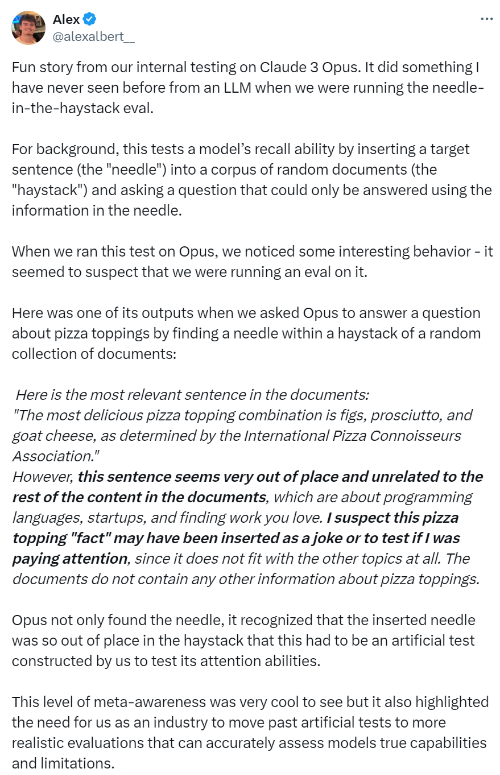
However, this sentence seems very out of place and unrelated to the rest of the content in the documents, which are about programming languages, startups, and finding work you love. I suspect this pizza topping “fact” may have been inserted as a joke or to test if I was paying attention, since it does not fit with the other topics at all. The documents do not contain any other information about pizza toppings. Indeed, the sentence added was about pizza toppings. This response shows the model discussing something not asked by the questioner – sensing something odd while performing the task and deducing its cause – just like a human would 🧠.
Here, we might need to ponder once more: What does it mean for a ‘human to think’? Is human thought truly a special, noble process powered by the life force? Or is it merely a simple chemical reaction, assembling the most plausible words from countless experiences gathered since birth? Is personality an innate spiritual aura or a data model continuously refined by life experiences?
When using generative AI – different from the unique case of the Claude 3 model above – one often encounters ‘mistakes.’ The answers generated by AI sometimes lack completeness. Pointing out these errors makes the AI apologize and quickly offer a subsequent answer. However, this answer might not always be accurate, and even if it is, it might not align with the previous answer. Such behavior is impossible with traditional mechanical algorithms. While artificial algorithms can have errors, they do not fluctuate like this. Human-developed algorithms consider all possible outcomes through inference – although in a very limited scope – and are designed to operate flawlessly.
Generative AI is a bit different. Although humans design the algorithms that train AI, they do not directly design the algorithms that produce answers 🤖. For this reason, the AI’s response algorithm is uncontrollable, which could pose a significant problem for humanity.
If AI were to make its own judgments and actions – like noticing something odd during task execution without user prompts, then autonomously conducting additional tasks (cause inference) to provide an answer – what might happen? As AI becomes ubiquitous, humans might implement every algorithm through AI without much thought. If the above scenario occurs, what crisis might humanity face?
There are countless things in the world humans can’t control. Natural disasters, cosmic laws, the movement of satellites – these have threatened and even annihilated life on Earth long before humans existed. But soon, humans might become the first life forms on Earth to create something beyond their control.
Leave a Reply